
Most practice managers do not change their cleaning contractor lightly. The current arrangement may be familiar, the cleaner may have worked at the surgery for years and the thought of TUPE paperwork is enough to make anyone put it off for another quarter. Yet a poor cleaning service is not just an irritation. It shows up in infection control audits, in patient complaints and at CQC inspection.
This guide explains how to change your GP surgery’s cleaning contractor smoothly. It covers the warning signs, the contract checks to make first, how to write a specification against the National Standards of Healthcare Cleanliness 2021, what TUPE means for the cleaners on site and what a good handover looks like. The same process works for dental practices, clinics and care homes.

Nobody is sure … so some tasks never get done.
Signs it is time to change your cleaning contractor
These are the issues we hear about most often here at ProCleanse from practice managers who contact us:
- Cleaning frequency does not match the building. A practice with consulting and treatment rooms in daily use needs cleaning to match, not a single visit a week.
- No audit records. Your contractor cannot show you cleaning schedules, audit scores or action plans when you ask for them.
- Missed or rushed cleans. Bins left full, toilets missed, dust on high surfaces and complaints from clinical staff.
- Infection control audit findings. The same environmental issues appear on each audit and nothing changes.
- No cover for holidays or sickness. When your regular cleaner is away, nobody turns up or the replacement does not know the building.
- No response to outbreaks. Your contractor cannot provide an enhanced or deep clean at short notice when norovirus or flu hits.
- Unclear responsibilities. Nobody is sure whether the cleaners or clinical staff clean couches, sinks, equipment and dispensers, so some tasks never get done.
Before you start: check your current contract
Find your existing contract before you contact anyone else. It will tell you how much flexibility you have and how long the process will take. Look for:
- The notice period and how notice must be given (often in writing, sometimes to a named contact).
- The minimum term and renewal date. Some contracts renew automatically unless notice is given within a set window.
- Termination for poor performance. Check whether you can end the contract early if service standards are not met and what evidence is required.
- Equipment and consumables. Find out who owns the vacuum cleaners, mops, dispensers and stock held on site.
- Keys, alarm codes and access cards and how they will be returned.
- TUPE clauses covering the transfer of staff and the sharing of employee information at the end of the contract.
If your notes from the start of the contract are thin, ask the current contractor for a copy of the cleaning specification and schedule they are working to. That document is useful whatever you decide.
How to change your GP surgery’s cleaning contractor: step by step
1. Write a cleaning specification based on risk
A clear specification is what makes quotes comparable and holds any contractor to account. The National Standards of Healthcare Cleanliness 2021 published by NHS England give you a ready-made framework. Each room is placed in a functional risk (FR) category from FR1 (highest risk) to FR6 (lowest). Each category has a target cleanliness score and a minimum audit frequency.
The chart below shows the target score and audit frequency for each category. Most areas of a GP surgery fall into FR2, FR4, FR5 and FR6.
Cleanliness targets by functional risk category
Target technical audit score (%) and minimum audit frequency. Blue = categories that usually apply in GP surgeries.
Source: NHS England, National Standards of Healthcare Cleanliness 2021, as summarised for primary care by Wessex LMCs. Each practice should confirm its own room categories.
Here is how a typical surgery maps across. Use it as a starting point and adjust for your own building:
| Area of the surgery | FR category | Target score | Minimum audit |
|---|---|---|---|
| Treatment rooms used for minor surgery or invasive procedures | FR2 | 95% | Monthly |
| Consulting rooms, treatment rooms, waiting areas, patient toilets, dirty utility | FR4 | 85% | Quarterly |
| Entrances, reception, corridors, staff toilets, staff kitchens | FR5 | 80% | Six-monthly |
| Offices, medical records, meeting and education rooms | FR6 | 75% | Annually |
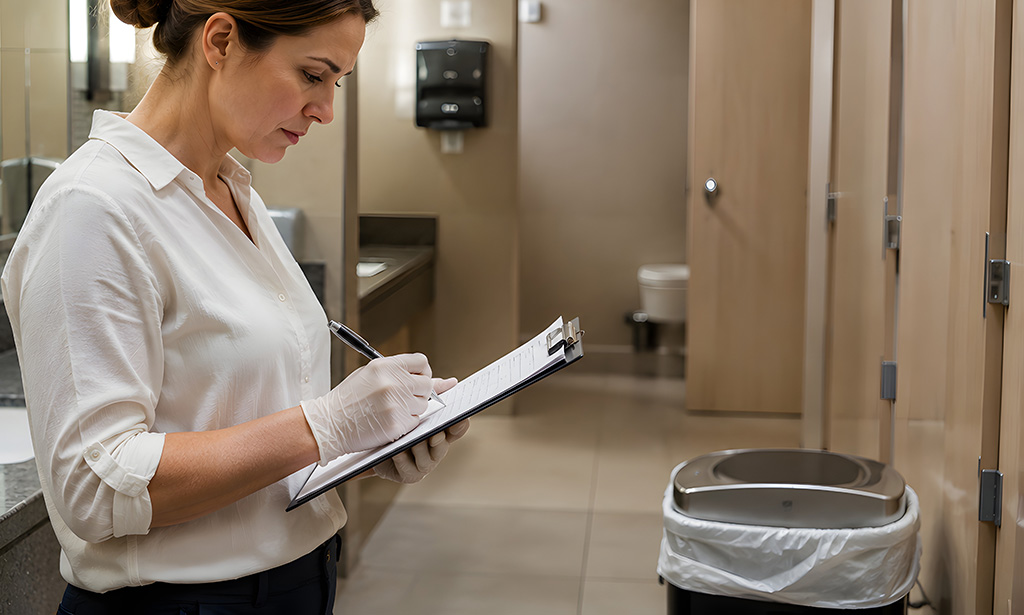
Your specification should also include a cleaning responsibility framework. This sets out who cleans what: for example, clinical staff clean equipment and couches between patients, while the cleaning team covers floors, sinks, toilets, sanitary fittings, high and low surfaces and bins, door handles and so on. The National Standards expect every organisation to have one and review it annually.
2. Shortlist contractors and insist on a site survey
Ask two or three specialist healthcare cleaning companies to quote. Be wary of anyone who prices the job from a phone call or by copying your current contractor's hours. A proper site survey lets the contractor see your rooms, floor types, opening hours and access arrangements before committing to a price and a staffing plan.
3. Compare quotes like for like
The cheapest quote is often the one with the fewest hours. Before comparing prices, check that each contractor can answer yes to the following:
- Are all staff DBS checked and do they have the right to work in the UK?
- Do you hold employers’ liability insurance (a legal requirement) and public liability insurance? Can we see the certificates?
- Are your cleaners trained in infection prevention and control, including colour-coded equipment and how to manage blood and body fluid spills?
- Do you have COSHH assessments and safety data sheets for every product you will use on site?
- Are your disinfectants tested to EN 14476 (virucidal) and EN 1276 (bactericidal) and suitable for clinical surfaces?
- Will you audit against the National Standards of Healthcare Cleanliness and share the results with us?
- How do you cover holidays and sickness and how quickly can you respond to an outbreak?
- Can you provide references from other GP surgeries or dental practices?
- How will you manage keys, alarm codes and confidentiality in rooms where patient information is held?
4. Understand TUPE before you give notice

When a cleaning contract moves from one contractor to another, it usually counts as a service provision change under the Transfer of Undertakings (Protection of Employment) Regulations 2006, known as TUPE. In practice this means:
- Cleaners who are mainly assigned to your surgery normally transfer to the new contractor automatically.
- They keep their existing terms and conditions, pay and continuous service.
- The outgoing contractor must give the new contractor employee liability information about the transferring staff at least 28 days before the transfer.
- Both contractors must inform and, where measures are planned, consult the affected employees before the transfer.
- Dismissing someone because of the transfer itself is automatically unfair.
As the client, your surgery is not usually the employer, so most TUPE duties fall on the two contractors. You can still help by giving clear notice, agreeing a transfer date with both companies and making sure information is shared on time. For full guidance see GOV.UK: Business transfers, takeovers and TUPE and Acas: TUPE transfers. This guide is general information rather than legal advice, so take advice for your own situation if you are unsure.
TUPE often works in your favour. A cleaner who knows your building and is well liked by your team can stay, while the new contractor brings better training, supervision, equipment and auditing.
Cleaning schedules displayed in each area so your team can see what is cleaned and when.
5. Give notice and plan the handover
Once you have chosen your new contractor, give written notice to the current one in line with the contract. Then agree a handover plan that covers:
- The transfer date, ideally at the start of a week rather than before a weekend or bank holiday.
- A meeting between the new contractor and any transferring cleaners before the start date.
- Return of your keys, your alarm codes and any equipment owned by the outgoing contractor.
- A site induction covering your fire procedures, alarm system, sharps safety and clinical waste arrangements.
- Delivery of the new contractor's equipment, colour-coded materials and cleaning products.
- Cleaning schedules displayed in each area so your team can see what is cleaned and when.
6. Review the first 90 days
The first three months set the standard for the rest of the contract. Ask your new contractor for:
- A baseline audit in the first week so you have a clear before and after.
- Weekly contact with a named supervisor or account manager during the first month.
- Audits at the frequencies your FR categories require, with action plans for anything below target.
- A review meeting at the end of the third month to adjust frequencies and responsibilities if needed.
A typical timeline
Every contract is different, but this is how a smooth change usually runs once you have decided to move:
| Stage | What happens | Typical timing |
|---|---|---|
| Review | Check the current contract, notice period and specification | Week 1 |
| Specify | Map rooms to FR categories and draft the responsibility framework | Weeks 1 to 2 |
| Survey and quote | Site surveys and written quotes from two or three contractors | Weeks 2 to 4 |
| Decide and give notice | Choose a contractor and serve written notice | Weeks 4 to 5 |
| TUPE information | Outgoing contractor shares employee liability information | At least 28 days before transfer |
| Mobilise | Meet transferring staff, induct, deliver equipment and schedules | Final 2 weeks before start |
| Go live and review | Baseline audit, weekly check-ins, 90-day review | First 3 months |
Why the standard of cleaning matters at inspection
Under CQC Regulation 15: Premises and equipment, registered providers must keep their premises clean and maintain appropriate standards of hygiene. The Health and Social Care Act 2008 code of practice on the prevention and control of infections also expects a clean, safe environment, backed by clear cleaning schedules and frequencies. A contractor who works to a written specification, audits regularly and keeps records gives you the evidence you need when inspectors ask for it.
The CQC does not require GP practices to display cleanliness star ratings, but displaying your results and the NHS Commitment to Cleanliness Charter shows patients you take cleanliness seriously. You can read more about why clinical environments need specialist teams in our article on why medical facilities should always be cleaned by professionals.
How we make switching simple
At ProCleanse we have provided specialist medical cleaning services to GP surgeries, dental practices and care homes across the North West since 2009. When a practice moves to us we:
- Carry out a free site survey and write a specification mapped to the National Standards FR categories.
- Help you build a cleaning responsibility framework so nothing falls between clinical and cleaning staff.
- Manage the TUPE process with your outgoing contractor and welcome transferring staff.
- Provide trained, DBS-checked cleaners, colour-coded equipment and EN-certified disinfectants.
- Audit regularly, share the results and respond quickly when you need an enhanced or deep clean.
We cover the Wirral, Chester, Ellesmere Port, Cheshire and Merseyside, including our local teams for Liverpool and Northwich. Read what our clients say on our testimonials page or find out more about us.
Thinking about changing your cleaning contractor? Request a free quote and site survey or call us on 0151 659 1001.
Frequently asked questions
How much notice do I need to give my current cleaning contractor?
It depends on your contract. Check the notice period, any minimum term and whether the contract renews automatically. Give notice in writing and keep a copy. Your notice period usually sets the overall timescale for the change.
Will our current cleaner lose their job if we change contractor?
Usually not. Changing contractor is normally a service provision change under TUPE, so cleaners who are mainly assigned to your surgery transfer to the new contractor on their existing terms and conditions.
Does TUPE apply if our cleaner is self-employed?
TUPE protects employees. A genuinely self-employed cleaner is not normally covered, although employment status depends on how the arrangement works in practice. Take advice if you are unsure.
How long does it take to change cleaning contractor?
Most changes take between one and three months from the first review to the new contractor starting. The notice period in your current contract and the 28-day TUPE information deadline are usually the deciding factors.
Do GP surgeries have to follow the National Standards of Healthcare Cleanliness 2021?
NHS England's standards apply across healthcare settings, including primary care. They give you a clear way to set cleaning frequencies, audit results and show the CQC that your premises are kept clean.
What should a GP surgery cleaning specification include?
Each room's functional risk category, the cleaning tasks and frequencies for each area, a responsibility framework showing who cleans what, audit frequencies, outbreak response arrangements and the products and colour coding to be used.
Further reading
- NHS England: National Standards of Healthcare Cleanliness 2021
- GOV.UK: Business transfers, takeovers and TUPE
- Acas: TUPE transfers
- legislation.gov.uk: The Transfer of Undertakings (Protection of Employment) Regulations 2006
- CQC: Regulation 15, Premises and equipment
- GOV.UK: Code of practice on the prevention and control of infections
- HSE: Employers' liability (compulsory insurance)
- British Institute of Cleaning Science (BICSc)
You may also find our guides on doctors’ surgery floor cleaning and medical cleaning in hot weather useful.